
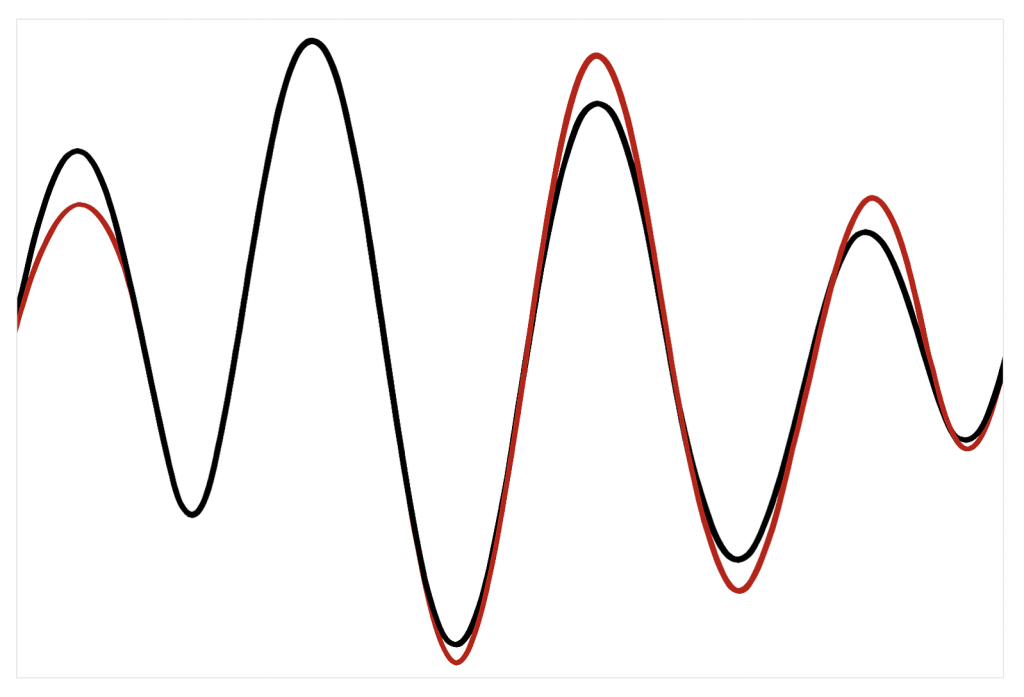
Measuring time-of-flight (ToF) with high precision normally demands specialised hardware, controlled environments, or complex signal processing. This technology takes a different approach. It extracts extremely small phase shifts from multi-frequency signals to deliver accurate delay measurements using simple transducers, scaling naturally from acoustics to ultrasound or even optical domains.
Originally conceived for smartphone-based temperature measurement—using the fixed geometry of the speaker–microphone pair—the concept has since evolved into a general-purpose ToF engine. It is robust in the presence of background noise, tolerant of imperfect hardware, and achieves timing resolution far beyond what would normally be expected from low-cost systems.
The key advantage lies in measuring time delay relative to wavelength rather than absolute sampling rate. In acoustic tests, delays were resolved to around 0.1% of a wavelength, equivalent to hundreds of nanoseconds at audio frequencies.
This level of precision enables high-fidelity air-temperature measurement and short-range distance sensing.
Because the underlying method is frequency-agnostic, the same principle extends to ultrasound for sub-millimetre interrogation, and in the longer term to laser-based ToF for inspecting microscopic structures—offering a potential route to non-contact metrology at chip scale.
Applications include environmental sensing, industrial inspection, robotics, process monitoring and precision alignment. Organisations interested in collaboration or licensing are invited to make contact.