-
![]()
Emerging Technologies
A pipeline of TRL 1–2 concepts that apply wave physics to new domains – from liquid-film optics and sonic water treatment to acoustic analogues of NP-hard optimisation problems. Open to collaboration with partners who want to shape the next generation of high-impact applications.
-
![]()
Damped Mode Attenuation
Damped Mode Attenuation provides targeted control of fan noise without introducing additional pressure drop. Unlike conventional splitters or resistive elements, the technology is tuned to the acoustic ‘signature’ of the fan itself, delivering attenuation exactly where it is most needed.
-
![]()
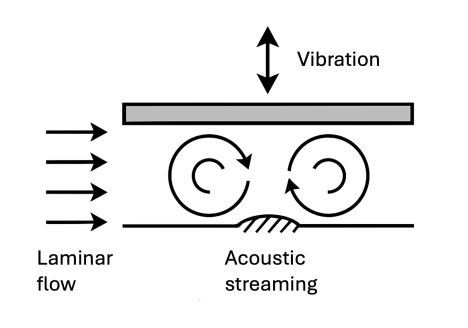
Battery Cooling via Acoustic Streaming
Vibration-enhanced cooling uses controlled acoustic streaming to disrupt the boundary layer in coolant channels, significantly increasing heat-transfer efficiency without raising flow resistance. Early studies indicate that lightweight actuation can deliver major thermal gains and enable meaningful reductions in pump power for compact liquid-cooled systems.
-
![]()
Time-of-Flight Measurement
Measuring time-of-flight (ToF) with high precision normally demands specialised hardware, controlled environments, or complex signal processing. This technology takes a different approach. It extracts extremely small phase shifts from multi-frequency signals to deliver accurate delay measurements using simple transducers, scaling naturally from acoustics to ultrasound or even optical domains.
-
![]()
High Performance Sound Absorption
Achieving broadband sound absorption with extremely thin materials is one of the longstanding challenges in acoustics. FISH Innovation has developed a metamaterial platform that delivers high absorption across wide frequency ranges at depths far below the acoustic wavelength.
-
![]()
Acoustic-Enhanced De-Alcoholisation
Reducing alcohol content in premium beverages is traditionally slow, energy-intensive and often compromises delicate aroma and flavour compounds. This technology takes a different approach. By using controlled acoustic micro-streaming to pre-condition the liquid before a low-temperature flash step, the mass-transfer rate of ethanol is significantly increased without resorting to high pressures, cavitation, or aggressive heating.