
Emerging Technologies
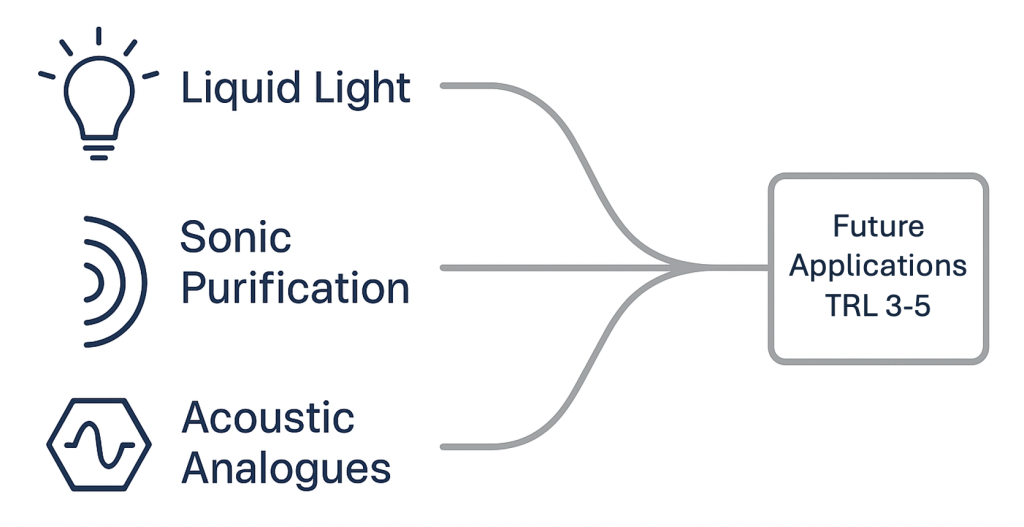
Wave-based ideas often start well before there’s a clear product – but that’s also where the biggest upside lives. This page highlights a set of early-stage concepts (roughly TRL 1–2) that are currently in exploration. Each uses wave physics in a different domain to unlock performance that looks unreachable with conventional approaches.
These technologies are not yet available as products, but FISH Innovation is actively developing the underlying physics and looking to shape future programmes with aligned research and industrial partners.
Liquid Light
Liquid Light is a controlled film-flow system that produces a continuously stable, low-velocity water curtain with internal illumination. Water is introduced from opposing sides and hydraulically balanced to achieve uniform laminar flow along both faces of the structure before merging at a precision knife-edge into a silent, turbulence-free cascade.
By carefully managing pressure, velocity and flow geometry, the system delivers a visually striking illuminated curtain without the acoustic artefacts normally associated with falling water. A submerged landing surface and low-profile recirculation loop complete the design, enabling permanent operation with minimal noise, low energy use and compact integration.
Potential applications include architectural installations, bespoke interior design features, experiential retail environments and premium hospitality venues.
Sonic Water Purification
Sonic Water Purification uses tightly controlled audible-frequency excitation to induce catastrophic membrane failure in waterborne bacteria. Unlike cavitation-based ultrasonic approaches, this method operates at modest drive levels and targets specific microbial vulnerabilities using narrow-band acoustic energy.
Research by FISH Innovation has identified frequency regimes that selectively disrupt the four pathogens responsible for the majority of global waterborne disease. The approach is silent, energy-efficient and chemically agnostic, offering the potential for compact, low-cost purification devices suitable for challenging environments.
Commercial opportunities exist in decentralised drinking water systems, point-of-use filtration, humanitarian response kits, and low-infrastructure sanitation technologies.
NP-Hard Acoustic Analogues
Many optimisation problems in logistics, networks and design are NP-hard: the solution space grows explosively and conventional algorithms struggle as systems scale. This line of work investigates physical analogues of such problems using acoustic wavefields, where interference, coupling and dissipation in a tailored structure act as a kind of analogue computer.
In these systems, candidate solutions are mapped to physical states or paths, and the acoustic field explores that landscape in parallel. The hope is that the system’s natural tendency to minimise energy or phase error can be harnessed to reveal near-optimal solutions faster or more efficiently than purely digital approaches.
This is very much a research frontier, but it aligns strongly with FISH Innovation’s broader theme: using real physical media – rather than abstract computation alone – to solve complex problems in new ways.